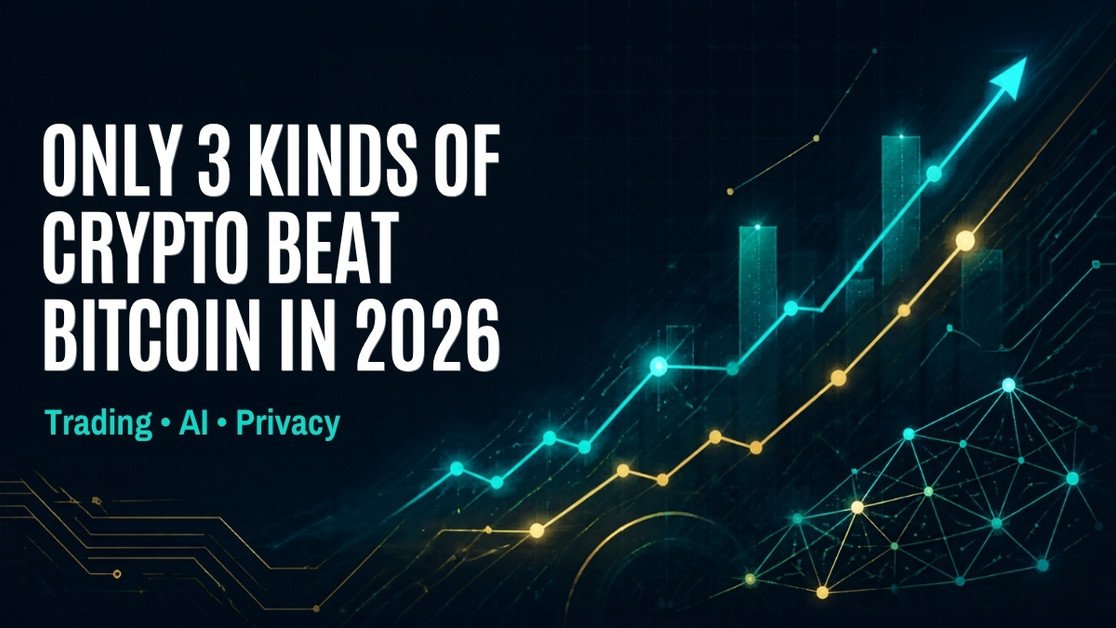
If you bought most cryptocurrencies this year and held them, you probably trailed Bitcoin. That is the blunt conclusion of a year-end review published on 27 October by DeFi researcher Ignas, reported by Odaily and KuCoin: since the start of 2026, only three categories of tokens have outperformed Bitcoin — trading tokens, AI tokens and privacy coins. Everything else, in his summary, has mostly performed poorly.
That replaces the usual question — “which coin is pumping today?” — with a better one: what actually earned its gains this year? In Ignas’s reading, the answer is tokens tied to real revenue, a real technology theme, or a real use case people keep coming back to.
1. Trading tokens: fees turned into value
The strongest group of all, according to Ignas, was trading-related tokens. Derivative exchange token DRV rose 665%, Hyperliquid’s HYPE rose 200%, PUMP rose 121% and Raydium’s RAY rose 106%.
The logic he gives is straightforward. When people trade on a decentralised exchange or launchpad, the platform earns fees, and some platforms use that revenue to buy back their own token or otherwise return value to holders. A busy trading venue can therefore support its token even in a choppy market — the token is, in effect, a claim on a cash-generating business rather than just a bet on future hype.
That does not make these tokens safe: trading volumes can collapse just as fast as they arrive. But it explains why this group led — in a year when most narratives faded, trading itself never stopped.
2. AI tokens: the year’s loudest theme — and today’s leader
AI was the second outperforming category. Ignas cites Venice AI’s VVV up 1,431%, NEAR up 203% and Grass’s GRASS up 151% since the start of the year.
The theme is still live right now. On 27 October, SoSoValue sector data reported by Odaily, PANews and TokenPost showed the AI sector leading the whole market with a 7.71% gain in 24 hours, ahead of PayFi at 2.06% and DeFi at 2.03%. The standout inside that move was Quack AI (Q), up about 252% in a day, with SoSoValue’s own SOSO token up 9.16%.
Here a careful reader should slow down. A 252% daily jump is not, on its own, evidence of a breakthrough. CryptoCompass’s review of Quack AI’s surge found no project announcement, listing or protocol event independently confirmed as the catalyst, and noted on-chain patterns consistent with a coordinated market-making campaign rather than organic demand. Quack AI was trading near $0.20, close to its all-time high of about $0.22 set the same day, after an all-time low of about $0.0057 in March.
The honest way to read the AI story, then, is in two layers. The broad theme — AI-related crypto projects attracting attention and capital all year — is real. Any single day’s 250% spike is not proof of anything, and it should never be chased on the strength of the percentage alone.
3. Privacy coins: the quiet comeback
The third outperforming group is the oldest idea in crypto: privacy. Zcash (ZEC) rose 137% this year and Monero (XMR) rose 37%, according to Ignas.
Zcash even outperformed Bitcoin again on Monday 26 October, rising over 3% while Bitcoin slipped about 0.3%, after developer group Zcash Labs launched Zcash JS — described by the group as a toolkit for building Zcash apps for the web, servers and mobile, from wallets to data dashboards. The toolkit is experimental, according to its GitHub page, so this is a building-block story rather than a finished product launch. But it fits the pattern: Zcash has kept shipping through long bear markets, helped by a development-funding model that sets aside part of each block reward, where Bitcoin miners keep the whole reward.
Privacy coins carry their own complications — regulators in several countries view them warily, and some exchanges have limited or removed them — so their outperformance is not a simple endorsement. It is, however, evidence that demand for private transactions has not gone away, even in an era of regulated stablecoins and bank-issued tokens.
What the rest of the market did
For context, the broader market on the evening of 26 October was cautious rather than euphoric. Bitcoin traded around $79,811, Ethereum around $2,314 and Solana around $100, as traders waited for the US Federal Reserve’s interest-rate decision on Wednesday 28 October. That caution makes the sector rotation more striking, not less: money did not flood into everything. It went, selectively, into AI names on the day, and over the year into the three groups above.
Ignas also flagged two institutional-adoption names outside the big three groups — QNT up 173% and Morpho’s MORPHO up 89% — as further examples of tokens with a concrete use case finding buyers. His broader takeaway, as reported, is that finding tokens with strong revenue-generating capacity remains a relatively straightforward trading approach at present. Read that as an observation about this year’s market, not as a promise about next year’s: revenue today does not guarantee revenue tomorrow.
The takeaway for an ordinary reader
Strip away the percentages and the lesson is refreshingly boring. The tokens that beat Bitcoin in 2026 were not, by and large, the ones with the loudest social media campaigns. They were tokens attached to something measurable: fees from real trading, a technology theme with sustained development, or a privacy feature people actually use.
That is a good filter to carry into the rest of the year. Before buying into a surge — especially a triple-digit daily spike like Quack AI’s — ask three questions: where does the revenue or usage come from, who is actually building, and would this token still matter if the hype stopped tomorrow? The three groups that outperformed Bitcoin this year mostly pass that test. Most of the market, by Ignas’s count, did not.
This article is for informational purposes only and is not financial advice. Figures quoted are as reported on 26–27 October 2026 by Odaily, KuCoin, PANews, TokenPost, Stocktwits and CryptoCompass, based on DeFi researcher Ignas’s year-end review and SoSoValue sector data; prices change quickly. Cryptocurrency markets are volatile — do your own research before making investment decisions.