
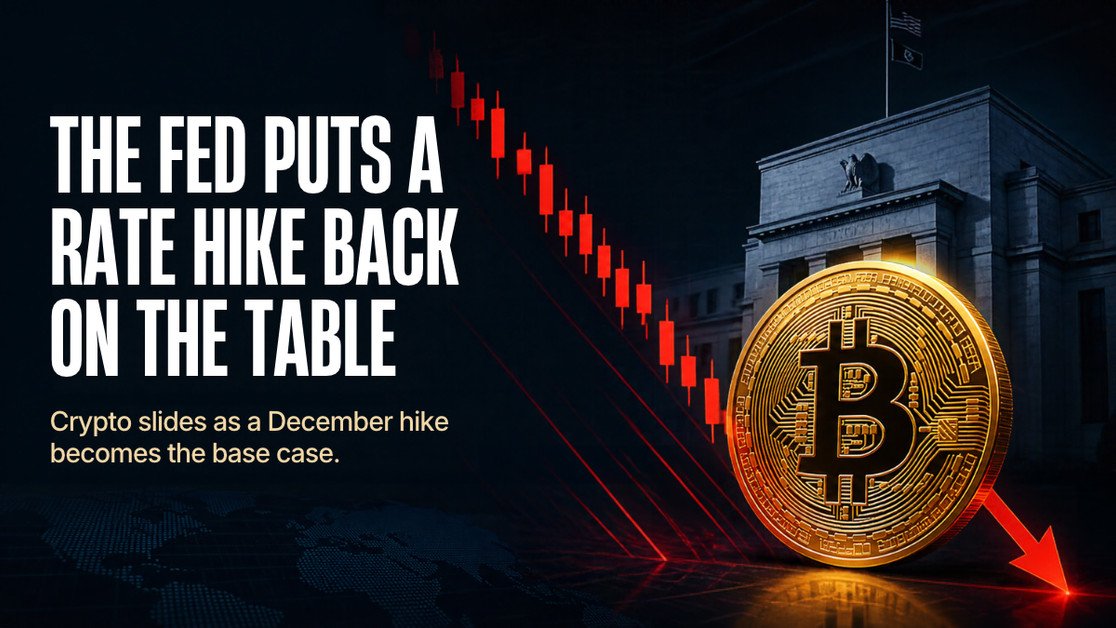
For weeks, crypto traders have been waiting for something — anything — to break the sell-off. On Wednesday, the news finally arrived. It was not the news they wanted.
The Federal Reserve published the minutes of its 27–28 October meeting, and the message was blunt: almost all of the central bank’s policymakers believe further interest rate increases will likely be needed to bring inflation back to 2%. Within hours, Bitcoin had slipped below $63,000, ether was under $1,800, and XRP had fallen back below the $1 mark. The market’s problem, it turns out, is not crypto at all. It is the cost of money.
What the minutes actually said
The Fed held its target range at 3.75% to 4.00% in October, on a 10–2 vote. The two dissenters — Governor Lisa Cook and Cleveland Fed President Beth Hammack — wanted a quarter-point hike there and then. But the real signal was in the discussion: almost all participants judged that further rate increases would likely be appropriate under their baseline outlooks, and a couple said a move larger than a quarter point could be considered at the next meeting, on 8–9 December, if inflation data disappoint.
Governor Christopher Waller went further in public the same day, telling CNBC the Fed should consider a half-point move in December. That is the scenario traders had not priced — and it is why Thursday’s jobless claims and next week’s inflation data matter more than usual.
Futures markets now put a December hike at roughly 95%, according to the CME FedWatch tool, with Polymarket pricing similar odds. A quarter-point rise is the base case. The question is whether the Fed stops there, or keeps going.
The market’s answer was swift
Bitcoin fell to around $62,500 on Wednesday, down roughly 3% on the day and about 12% over the past week. Ether slid to about $1,770, XRP dropped 1.5% to roughly $0.96, and Solana fell to around $73. The Fear & Greed Index sits near 11 — deep in extreme fear territory, where it has camped for much of the month.
The ETF flows tell the same story. US spot Bitcoin funds lost a net $239.9 million on Tuesday 17 November, according to Farside data, with BlackRock’s IBIT accounting for $209.5 million of it — one day after a small $7.9 million inflow had ended a seven-session outflow streak. Ether funds lost a further $29.1 million. The pause, in other words, lasted exactly one session.
Even Nvidia could not save the day
Here is the telling detail: crypto did not fall because of bad news about crypto. It fell on a day when the biggest company in the world reported a blowout quarter — and still could not lift risk assets.
Nvidia posted third-quarter revenue of $115.8 billion, up 103% on a year earlier, and guided fourth-quarter revenue to $130 billion, with data-centre revenue of $107.6 billion. The shares rose about 3% before the open, then reversed to close down 2.89% at $150.96. The S&P 500 slipped 0.23% for a fifth straight loss; the Dow fell 1.11%. Only the Nasdaq managed a gain, up 0.42%.
Bitcoin, which had traded near $64,700 in the morning, gained barely half a percent while Nasdaq futures jumped — then gave it all back and more once the minutes landed. AI earnings strength is not carrying into crypto while a rate hike is priced above 90%. The market is trading on rates, not on earnings.
Why a rate hike hits crypto so hard
For readers who have wondered why a central bank meeting in Washington moves a digital asset traded around the clock, the mechanism is straightforward — and it has nothing to do with Bitcoin itself.
First, higher rates mean higher yields on the safest assets in the world: cash and US government bonds. When a Treasury bill pays more than 5%, the case for holding a volatile asset that pays nothing gets weaker, and some capital simply moves to the safer return.
Second, higher rates tend to strengthen the dollar, and crypto is priced in dollars. A stronger dollar makes Bitcoin more expensive for buyers in other currencies, quietly draining demand.
Third, borrowing gets more expensive. Much of crypto’s trading runs on leverage — borrowed money — and when the cost of that money rises, leveraged positions become harder to hold. That is the same dynamic behind the $2 billion liquidation cascade earlier this month: forced selling feeds on itself.
The minutes added a fourth wrinkle. Policymakers flagged the rapid growth of AI-related debt, often through complex or opaque structures, and discussed risks around hedge-fund leverage. In a market already nervous about leverage, that is not reassuring language.
None of this makes Bitcoin’s long-term story better or worse. It makes the next few weeks harder to predict, because the asset is trading as a risk asset — and risk assets are currently priced by the Fed.
What to watch next
Three things matter from here. The first is the data: Thursday’s jobless claims, then the inflation figures that land before the December meeting. Hot numbers strengthen the case for a bigger hike; soft numbers give the Fed room to go slow.
The second is the December meeting itself, on 8–9 December. A quarter-point rise is almost fully priced, so the surprise would be either a half-point move — the scenario Waller floated — or language suggesting the tightening continues into 2027. Traders are already pricing more than 80 basis points of tightening by September next year.
The third is the $60,000 level. Bitcoin’s weekend low near $61,947 is the line analysts are watching; a clean break below it could trigger another wave of forced selling, while holding it — and reclaiming $68,000 — would be the first sign the selling has run its course.
There is one more date on Thursday’s calendar: the Senate Banking Committee holds a hearing at 10am Eastern for two SEC nominees, Johnson and Levine. It will not move rates, but it could shape how the next SEC treats crypto — a reminder that Washington is pulling at this market from more than one direction at once.
For now, the message from the Fed is the one that counts. Rate cuts are off the table. Rate hikes are back on it. And until that changes, crypto will keep trading on the Fed’s calendar, not its own.
This post is for information only and is not financial advice. Figures are as reported by the Federal Reserve, FXStreet, Reuters, Farside, CoinMarketCap and FinanceFeeds on 18–19 November 2026. Forecasts and probabilities cited are those of the named analysts, prediction markets and data providers, not this site. Cryptocurrency markets are volatile — do your own research before making investment decisions.