On Monday morning, an American investor could buy a piece of Coinbase at 9 a.m. — and keep buying it at 9 p.m., midnight, or 3 a.m. on a Sunday. The shares never touched the New York Stock Exchange. They traded as tokens on a blockchain.
That is the promise of tokenized stocks, and this week it took its biggest step yet into the regulated US market. OKXICE — a joint venture between crypto exchange OKX and Intercontinental Exchange, the parent company of the NYSE — opened tokenized stock trading to eligible US customers on Monday 23 November, under the SEC’s temporary Innovation Exemption. It arrived with a twist: most of the companies whose shares were supposed to be listed wanted nothing to do with it.
What a tokenized stock actually is
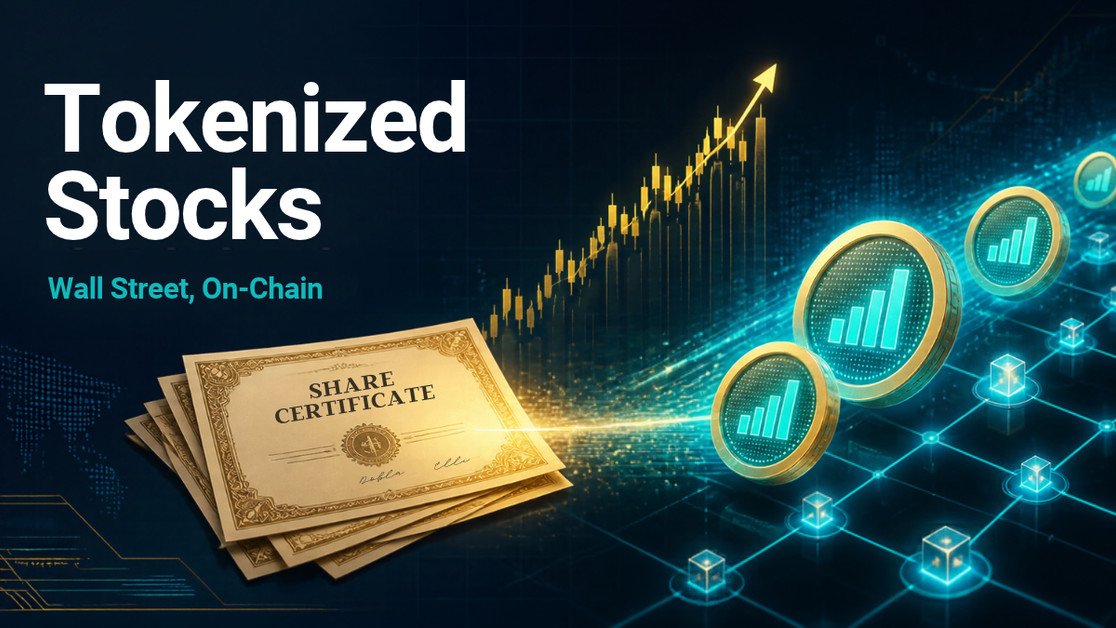
Strip away the jargon and the idea is simple. A tokenized stock is a digital token that represents a share in a listed company. A regulated issuer holds the real share in custody and mints a token against it, one for one. The token can then be traded around the clock, in fractions, by anyone the platform accepts.
The appeal is obvious. Stock markets close; blockchains do not. A trader in Karachi or Manila can buy a slice of a US tech stock at midnight without a brokerage account, and the token can be used inside decentralised finance — borrowed against, pooled, or swapped — in ways a share sitting in a broker’s vault cannot.
The market is already bigger than most people realise. Tokenized stocks were worth about $3.40 billion across 4.95 million holders on 21 November, according to the rwa.xyz tracker, with Binance’s bStocks holding roughly $1.2 billion and Ondo’s tokens about $839 million. Kraken’s xStocks programme recently passed 1,500 assets after adding 200 UK and EU stocks. The DTCC, the clearing giant at the heart of US markets, said on 12 November that it plans to connect its tokenisation service to Solana in the second half of 2027.
The launch that shrank
OKXICE was billed as the big one: more than 70 assets, including 59 Direxion ETFs and tokenized shares of seven named companies. But as the opening approached, the list kept shrinking. By the 20 November notice, only six stock tokens remained — Coinbase, Circle, Robinhood, Strategy, Securitize and BitGo — each paired with the USDC stablecoin and tokenized by Securitize Markets. Whether the 59 ETFs would trade on day one was, as of Monday, unconfirmed.
The reason is written into the objections file. Of the 62 companies OKXICE named in its 4 October notice, 56 had formally objected by 5 November, and CoinDesk’s tally put total objections at 67. The six that did not object are all crypto-linked businesses. Not a single company from outside the digital-asset industry agreed to have its stock tokenized.
The big names stayed away for understandable reasons. Nasdaq has warned that trading the same shares across disconnected platforms could fragment liquidity and make prices less reliable. And the venue itself is deliberately small: each token is capped at 0.25% of the underlying stock’s prior-month trading volume, a ceiling that keeps tokenized trading from moving the real share price — and bounds how far the venue can grow.
There is also a structural quirk worth knowing before anyone trades. OKXICE prices come from automated market-maker pools built on Uniswap v4 on X Layer, OKX’s own blockchain, rather than from an order book. The venue’s own disclosure says pool prices can drift away from the real share price, especially outside regular market hours or when liquidity is thin.
Meanwhile, the offshore market is booming
While the US launch was narrowing, the established offshore market was setting records. Bitget’s rToken, the tokenized-stock product run by Reality, recorded $200 million in daily spot volume on 21 November — its highest since launching in June — with a weekly record of $621 million and more than $200 million in total value locked. Four-week volume is up 366%.
The contrast tells the story of this market in 2026: the demand is real and growing, but the regulated US version is starting small, cautious, and — for now — mostly crypto companies trading crypto companies’ shares.
The catches nobody should skip
Tokenized stocks come with trade-offs that the marketing rarely leads with. An October study by the International Monetary Fund found tokenized stocks were about 1.5 times as volatile as the same stocks in traditional markets — the round-the-clock trading that makes them attractive also means there is no closing bell to stop a slide. Token holders generally do not get the voting rights or shareholder protections that come with holding the real share. And supply is not guaranteed: Binance’s recent campaign for tokenized Anthropic shares secured only 2,957 shares against $500 million of interest, and the exchange is refunding the locked funds.
None of that makes the idea a dead end — the first trades under the SEC’s Innovation Exemption already happened on 4 November, when TSV LLC hosted trades in Canton Strategic Holdings shares. But the honest read on this week’s launch is that it is a pilot wearing a launch’s clothes: six crypto-linked stocks, tight volume caps, and prices that can wander from the real thing after hours.
For the crypto-curious reader, the thing to watch is not the opening-day volume but the objections file. The day a company outside crypto — a bank, a retailer, a manufacturer — willingly lets its shares be tokenized, the experiment becomes a market. Until then, tokenized stocks are a working bridge between two financial worlds that still mostly distrust each other.
This article is for information only and is not financial advice. Figures are as reported by Cointelegraph, The Defiant via TechTimes, Coinotag, Blockchainreporter, rwa.xyz, the IMF and Bitget/Reality on 11–24 November 2026. Tokenized stock prices can diverge from the underlying share price, and token holders may not receive shareholder rights. Cryptocurrency markets are volatile — do your own research before making investment decisions.