
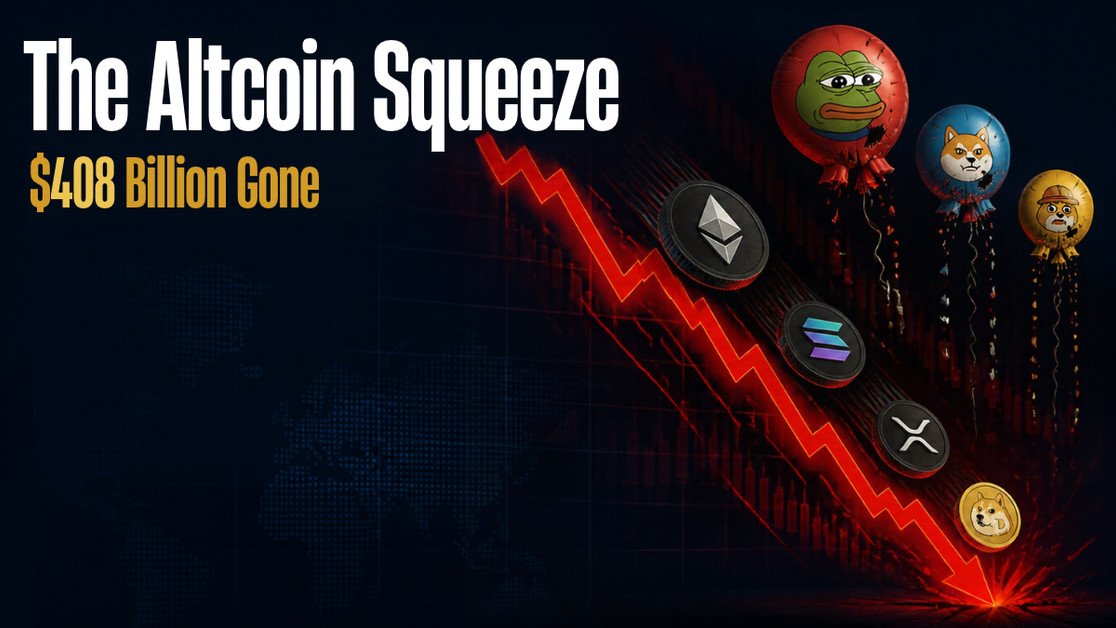
The altcoin party is over — and the clean-up bill is enormous. Since the market peaked in September, everything in crypto except Bitcoin has lost $408 billion in value, a 34% collapse that has left four out of five altcoins trading below their long-term trend lines. And the wildest corner of the market, meme coins, has been hit hardest of all: their share of the altcoin market has shrivelled from 11% at the height of the 2024 mania to just 2% today.
The figures come from a CryptoQuant analysis by Darkfost, published on 24 November, and they paint a picture of a market that has quietly given up on risk. The TOTAL2 index — which tracks the value of all crypto assets except Bitcoin — is down by a third from its September peak. On Binance, the share of altcoins trading above their 200-day moving average has fallen from 90% in September to just 19%. In plain terms: almost every altcoin is now in a downtrend.
The meme-coin deflation
No segment tells the story better than meme coins. In November 2024, at the peak of the speculative frenzy, meme coins accounted for roughly 11% of all altcoin value. Today that figure stands at 2% — an 82% relative collapse in their share of the market, and a record low for the measure.
The selling has been relentless rather than sudden. Binance trading data shows a cumulative $1.5 billion imbalance in favour of sellers in meme coins, with selling pressure persisting since October 2025. Solana meme coins have lost roughly half their combined value since late August, according to BeInCrypto, and the big names have all been dragged down with them. Dogecoin traded at around $0.055 on 24 November, down 32% over the past month. Shiba Inu fell 29% over the same period to $0.0000036, and Pepe lost 24% to $0.0000035.
Darkfost’s warning is blunt: a historically low market share does not mean meme coins are cheap or that a recovery is near. The money has simply walked away — and, for now, it is not coming back.
Why altcoins are falling harder than Bitcoin
Altcoins almost always fall further than Bitcoin in a downturn, and this one is no exception. The wider market has been sliding for weeks. Bitcoin slipped back below $60,000 on Tuesday, trading near $59,100, after a brief rally above $64,000 on Monday faded almost as fast as it arrived. Ether was hovering around $1,660. The total crypto market is worth about $2.07 trillion, down 4.7% in 24 hours, and only 10 of the 100 largest coins were in the green.
Behind the slide is a steady institutional exit. US spot Bitcoin ETFs recorded $569.7 million in net outflows on Monday 23 November — their fifth straight day of withdrawals — taking November’s total to $4.71 billion, already the largest monthly outflow since the funds launched. Only two of the month’s sixteen trading sessions have seen inflows. Ether ETFs lost $84.9 million the same day, their sixth straight outflow, taking their November total to $1.15 billion after a record $1.61 billion left in October.
Sentiment has collapsed with the prices. The Crypto Fear & Greed Index read 11 on 24 November — deep in “Extreme Fear” territory — and Bitwise said this week that crypto sentiment is at one of its lowest levels since the FTX collapse in 2022. When fear is that intense, traders sell the riskiest assets first, and nothing in crypto is riskier than a small altcoin or a meme token.
A market with thinner defences
There is another reason the altcoin sell-off has been so brutal: the market is simply more fragile than it was. Darkfost pointed to more than 207 exploits across the crypto industry in the first half of 2026 alone — already a record — while DeFiLlama had logged 367 hacks in 2026 by 24 November, nearly triple the count at the same point last year. Every exploit chips away at confidence in smaller projects, and in a market with thin liquidity, confidence is everything.
Meanwhile, the rules are being rewritten
While traders nurse their losses, one of Asia’s biggest markets is quietly preparing for the next cycle. South Korea’s Financial Services Commission unveiled a draft Digital Asset Basic Act on 24 November that would lift the country’s nine-year ban on initial coin offerings, in place since September 2017. Under the proposal, domestic projects could issue and sell tokens again — but only after filing detailed disclosures with the regulator, with false statements punishable by civil damages, fines and even criminal prosecution.
The same bill would hand won-backed stablecoins to bank-majority consortiums and cap any single shareholder’s stake in a crypto exchange at 20%. It still needs approval from South Korea’s National Assembly, so nothing changes overnight. But the direction is clear: the country that banned ICOs after the 2017 fraud wave now wants the fundraising — and the jobs — back onshore, under rules rather than in the shadows.
What it all means
The $408 billion figure is a valuation loss, not cash that left the market — CryptoQuant is careful to make that distinction. But the message of the last two months is hard to miss: altcoin breadth has collapsed, the meme-coin casino has emptied out, and the institutions that were supposed to be the new buyers are selling instead. Markets that fall 34% in two months have a habit of bouncing hard when sentiment turns — but until the ETF outflows stop and the fear gauge climbs out of single digits, the altcoin squeeze is likely to grind on.
Sources: CryptoQuant (Darkfost, 24 Nov 2026), CoinDesk, Decrypt, crypto.news, BlockchainReporter/Farside Investors, Coinbell, KuCoin daily market report, BeInCrypto via The Bit Journal.
This article is for information only and is not financial advice. Figures are as reported by CryptoQuant, CoinDesk, Decrypt, crypto.news, BlockchainReporter/Farside Investors, Coinbell, KuCoin and BeInCrypto on 24–25 November 2026. Cryptocurrency markets are volatile — do your own research before making investment decisions.