Bitcoin barely moved on Friday. Ethereum barely moved either. After a week in which the whole market lost roughly a fifth of its value from the autumn highs, that stillness is not calm — it is a market holding its breath. The next thing that matters for crypto is not a protocol upgrade, an ETF decision or a whale wallet. It is a US inflation report, due Tuesday, and what it says about whether the Federal Reserve raises interest rates again in December.
That is an uncomfortable sentence for anyone who believes crypto trades on its own story. This month, it mostly does not.
One jobs report rewrote the rate path
Friday’s US jobs report landed far hotter than anyone expected. Employers added 165,000 jobs in October, against a consensus forecast of about 65,000, while unemployment held at 4.1% and average hourly earnings rose 0.4% in the month — 3.1% over the year. Strong hiring is normally good news. For a market that had been hoping the Fed’s tightening cycle was over, it was the opposite.
Bitcoin slipped about 1.1% after the release, touching an intraday low near $74,888 before steadying around $75,854. Ethereum settled near $2,230. CoinGlass data showed about $468 million in leveraged positions liquidated in 24 hours. The real move, though, was in rate expectations: the market-implied probability of a December Fed hike jumped to about 77–78%, from roughly 67–70% before the report — and from below 70% during Thursday’s stock-market panic, when traders had briefly doubted the hike would happen at all. The 10-year Treasury yield rose to about 4.86% and the dollar index gained 0.72%.
The context matters. The Fed raised rates in mid-September — its first increase since 2023 — then held its target range at 3.75% to 4.00% on 28 October in a 10–2 vote, with two officials dissenting in favour of another hike. Futures now price a December move to 4.00–4.25% as the base case. Crypto has spent three weeks learning to trade a tightening Fed, and the repricing is not finished.
Why Tuesday’s CPI decides everything
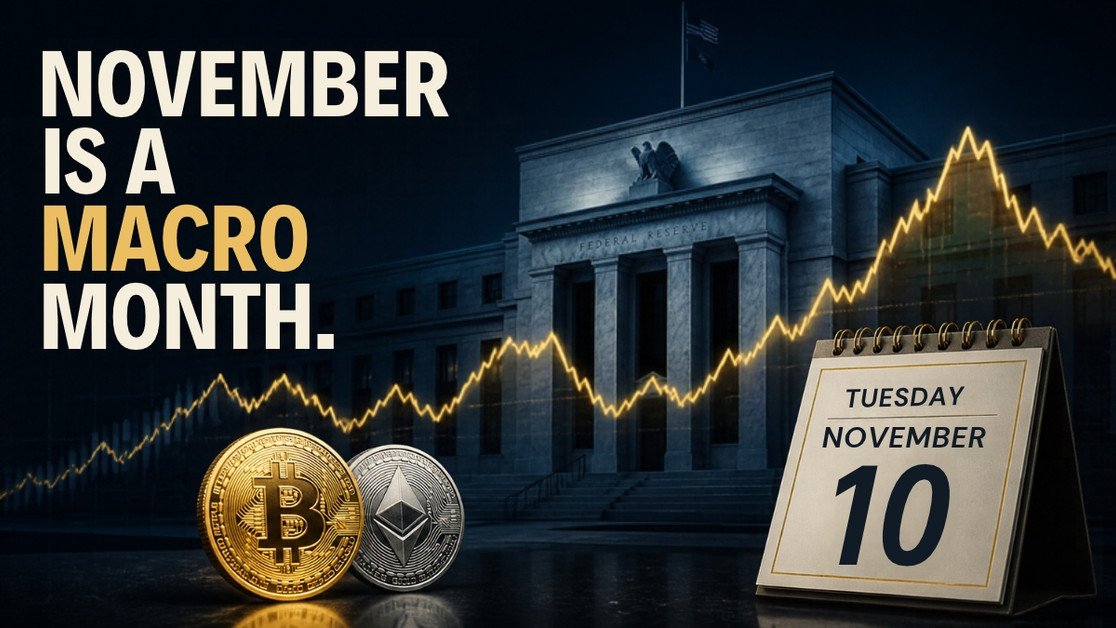
The October consumer price index lands on Tuesday, 10 November, at 8:30 a.m. Eastern — and it is the last inflation reading the Fed sees before its 8–9 December meeting, because November’s CPI arrives on 10 December, a day after the decision. That makes it the single most important data point of the month for every risk asset, crypto included.
The setup is lopsided, and that asymmetry is the story. With a December hike already about three-quarters priced, a hot core reading can add at most 23 to 27 percentage points of probability — but a soft one has up to 73 to 77 points to remove. Nowcasts put October core CPI near 0.2% month-on-month. The last official print, September’s, came in hot at 3.7% year-on-year with core at 2.6%, and that single release sent Bitcoin down about 2% in a day. A soft Tuesday print could unwind the whole October repricing fast; a hot one would near-certainly lock in December and extend the downtrend into year-end.
As one November outlook put it plainly, the variable that decides the month is the mid-November CPI print — if October CPI comes in at or below roughly 3.4%, December hike odds compress and the repricing reverses; if it prints at or above 3.7% again, December becomes a near-certainty. That is a forecast framework, not a guarantee — but it gives the market a clear test to watch.
The analysts: a bottom call, and a list of conditions
Analyst Michaël van de Poppe, a widely followed crypto trader, projected a Bitcoin bottom on Friday, potentially after sweeping the $75,000 level — the kind of level-sweep that clears out leveraged longs before a bounce. It is one trader’s call, and it cuts both ways: if $75,000 breaks cleanly, the next supports sit far below.
The broader analyst view is more cautious. The same November outlook that frames this as a macro month sets a choppy, range-bound base case with a downside skew into mid-November, and names three things that would change its mind: Bitcoin reclaiming and holding $87,397, its September high; Bitcoin dominance falling below roughly 57% while total market capitalisation stays flat; or the CPI print coming in soft enough to compress hike odds. If none of those happens by the December meeting, the note says, the tightening thesis holds and there is nothing new to say about November.
The flows agree with the caution. US spot Bitcoin and Ethereum ETFs recorded combined net outflows of about $530 million in the 5 November session alone, extending a run that saw roughly $1.16 billion leave Bitcoin funds over the three trading days from 30 October to 3 November. Crypto, in the words of one CoinDesk market note, has returned to its pattern from earlier in the year: going down when stocks go down, but not really participating when equities surge.
The quiet counter-signal: record staking
There is one corner of the market behaving as if none of this matters — and it is worth more attention than it gets. Ethereum staking hit a record 43.8 million ETH in the third quarter, or 35.9% of total supply, according to Bitwise’s staking report, with net inflows of 1.99 million ETH marking a sixth consecutive quarter of positive inflows. Solana’s active stake climbed to 440.5 million SOL. And this is happening while yields fall: Ethereum’s average annualised staking yield dropped to 2.63% from 2.81%, and Solana’s to about 6% from 6.38%.
That is a strange combination on its face — more money locking up for less reward. The explanation is that staking has become a portfolio fixture rather than a yield chase: easier access through staking ETFs and treasury products, and holders who are locking tokens for years rather than trading the month. Nearly all of the yield — 96.3% on Ethereum, about 90% on Solana — now comes from new token issuance rather than fees, which is a reminder that the economics are thinner than the headline rate suggests. But the direction of travel is unmistakable: while traders sell, long-term holders keep locking supply away.
Two other structural notes from the week point the same way. Core Scientific, once a major Bitcoin miner, announced it is fully pivoting to AI data centres and will exit Bitcoin mining by 2027, after colocation revenue reached $215.4 million in the third quarter. And Blockstream highlighted Falcon-1024 as its top choice among quantum-resistant signature algorithms for Bitcoin — a long-horizon project, but one that shows the industry’s biggest names are already building for a post-quantum decade.
What to watch next
- Tuesday’s CPI, 8:30 a.m. Eastern. A soft core print (near 0.2% month-on-month) could cut December hike odds sharply and lift risk assets; a hot one locks in the hike.
- Whether $75,000 holds. Van de Poppe’s bottom call depends on a sweep and recovery, not a clean break. A decisive break opens the way toward the low-$70,000s.
- Whether ETF flows reverse. Several days of sustained inflows would be the first real sign institutional caution is lifting. One day would be noise.
- The December 8–9 Fed meeting. The decision, plus updated projections, will set the rate path into 2027 — and the market is currently pricing further tightening next year.
- Staking versus selling. If record staking keeps climbing while ETF outflows continue, the split between long-term holders and short-term traders will only widen — and the question is which group is right.
November will be decided in Washington, not on a blockchain. The inflation print on Tuesday is the next chapter, and it is the one that decides whether the month’s sell-off was a repricing that is nearly done — or one that has further to run.
This post is for information only and is not financial advice. Forecasts are attributed to the analysts and publications named, and figures are as reported by the Bureau of Labor Statistics, CoinGlass, Bitwise via CoinDesk, Market Briefer, CoinDesk and other outlets on 6–7 November 2026; they will change. Cryptocurrency markets are volatile — do your own research before making investment decisions.