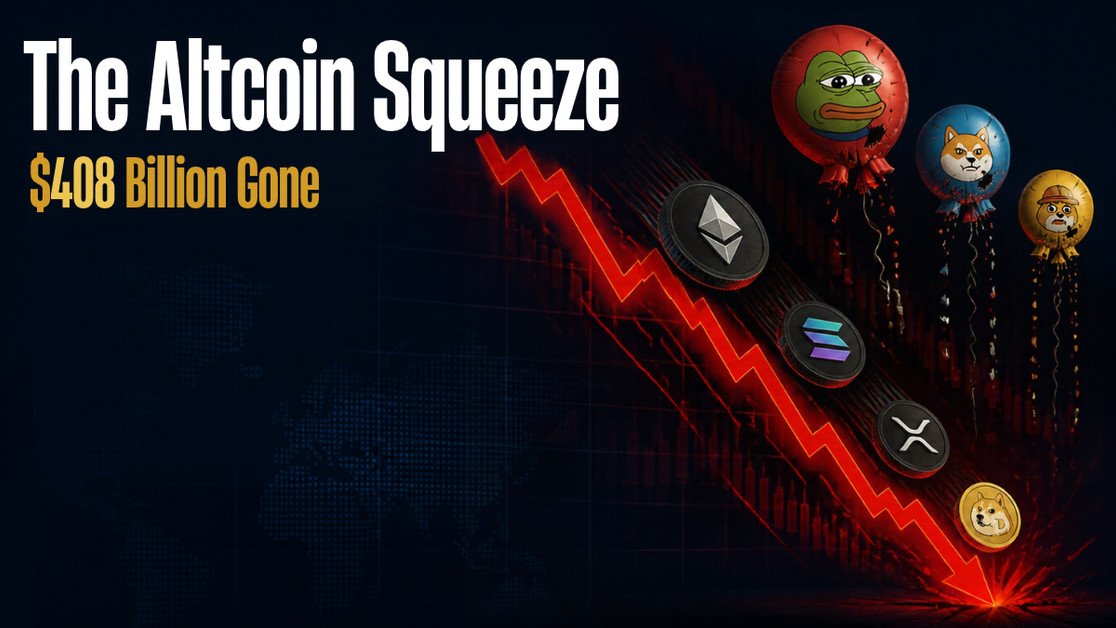

Bitcoin fell below $58,000 on Wednesday, recovered above $61,000 within a day, and left $515 million in liquidated leveraged bets behind it. The Nasdaq 100 entered a bear market, and roughly $2 trillion was wiped off US stocks at the open. None of it started in crypto — and that is exactly the point. This is a story about how the wider economy grabs crypto by the collar, and why crypto keeps falling harder than the stock market that drags it down.
The trigger: inflation that would not cool
The day began with the numbers every trader had been waiting for. US core PCE inflation — the Federal Reserve’s preferred measure — rose 3.3% year on year in October, its highest reading since November 2023 and above the 3.2% economists had forecast. Headline PCE came in at 3.8%. The economy, meanwhile, looked anything but weak: third-quarter GDP growth was revised up to 4.3%, well above the 3.5% expected, and weekly jobless claims fell to 189,000.
Together, the data told one story: strong growth plus sticky inflation — which points to a Federal Reserve that may need to raise rates again rather than cut them, after months in which investors had priced in the opposite. Higher rates make borrowing more expensive, squeeze profits, and pull money toward safe assets like government bonds. Risk assets of every kind sell off — and crypto, the riskiest corner of all, sells off fastest.
Then came the tariffs
As if the inflation print were not enough, the Trump administration proposed new tariffs on 14 major trading partners, with rates of up to 40% on goods from China and up to 35% on Vietnam. Tariffs tax imports, raising business costs and consumer prices while slowing trade — markets read them as both an inflation risk and a growth risk at once. The Nasdaq fell 3.34% at the open, the S&P 500 dropped 2.30%, and the Dow lost 1.56%.
Bitcoin, which had been drifting near $59,000, slid more than 4% to about $57,300, according to The Block. Ether fell 2.6% to around $1,650, and the total crypto market value dropped to $2.08 trillion, its lowest since September 2024. By the close, stocks had recovered much of their losses — the Nasdaq ended down just 0.62% — and crypto followed, with Bitcoin reclaiming $60,000 and then pushing above $61,000. But the damage was done: about $515 million in leveraged positions had been liquidated in 24 hours, according to CoinGlass.
Why crypto falls further than stocks
The same shock hits both markets, but crypto amplifies it in three ways.
The first is the buyers walking away. US spot Bitcoin ETFs have now recorded six consecutive sessions of net outflows, taking November’s total to approximately $4.94 billion — the largest monthly outflow since the funds launched in 2024. BlackRock alone accounts for about $3.81 billion of that since 1 November. When the biggest buyers become sellers, there is nobody left to catch the fall.
The second is how much of crypto trading is now borrowed money. On Binance, Bitcoin perpetual futures volume reached eight times spot volume in October — the highest ratio since the product launched in 2019, and more than double the 2025 average of about 3.9 times. Perpetuals let traders bet with leverage, putting down a fraction of the position’s value. When prices drop, those positions are forcibly closed — liquidations — which means more selling, lower prices, and more liquidations. A 4% dip becomes a cascade.
The third is sentiment. The Crypto Fear & Greed Index read 11 on Wednesday — deep in “Extreme Fear” territory. In that mood, every headline reads as a reason to sell.
What the analysts say comes next
Matt Mena, senior crypto research strategist at 21shares, told Bitcoin.com News on 25 November that Bitcoin’s realised price — the average cost basis of all Bitcoin in circulation, roughly $53,000 — is the line in the sand: “A sustained break below it could put $48.5K bitcoin in play.” But Mena also expects Bitcoin to revisit $72,000 to $80,000 by year-end, arguing that a move above $65,000 would strengthen the case that the $55,106 low of 21 November marked the cycle bottom.
The model-based forecasts are more muted. YouHodler’s price model, updated on 25 November, puts its central scenario for the end of November at $59,690, with a range of $52,861 to $67,402 — effectively no clear direction. CoinDCX’s model sees Bitcoin between $54,900 and $62,500 over the next week, with a base case near $58,700.
The market is sitting on a knife’s edge. KuCoin’s daily report puts the levels plainly: Bitcoin needs to hold $57,000–$58,000, with a break below opening the way to $55,000 and $53,000; on the upside it must reclaim and hold $61,000–$62,000, then break above $63,000–$65,000, to ease the pressure.
Meanwhile, the rulebook kept changing
While prices whipsawed, Washington and Kyiv were busy rewriting the rules. The US Justice Department said its largest-ever crackdown on crypto scam networks targeted more than 800 defendants, with raids on scam call centres and compounds mainly in Southeast Asia. Ukraine’s parliament passed a virtual-asset bill with 271 votes, legalising crypto from July 2027 with a 5% tax through 2028.
Fidelity filed with the SEC for a spot Chainlink ETF — the FLNK fund, holding LINK directly without staking — a day after adding Chainlink, Aave and Uniswap to its retail platform. And a bill to create a US Strategic Bitcoin Reserve, barring the sale of reserve Bitcoin for at least 20 years, cleared the House Financial Services Committee.
What to watch
Three things will decide whether Wednesday’s recovery holds. First, the ETF flows: until the outflows stop, every rebound is built on thin spot demand. Second, the levels — $57,000–$58,000 below, $61,000–$62,000 above. Third, the calendar: Thanksgiving thins out trading, and Friday brings a large options expiry, which can amplify short-term moves in either direction.
The lesson of the week is one crypto keeps relearning: the market may run on its own technology, but it still trades on the world’s money. When inflation runs hot and tariffs fly, Wall Street sneezes — and crypto catches the cold.
This article is for information only and is not financial advice. Figures are as reported by KuCoin, The Block, CoinGlass, Bitcoin.com News (21shares), YouHodler, CoinDCX, BACOOR News, WEEX and BlockBeats on 25–26 November 2026. Forecasts quoted are the views of the analysts named, not predictions by this publication. Cryptocurrency markets are volatile — do your own research before making investment decisions.