
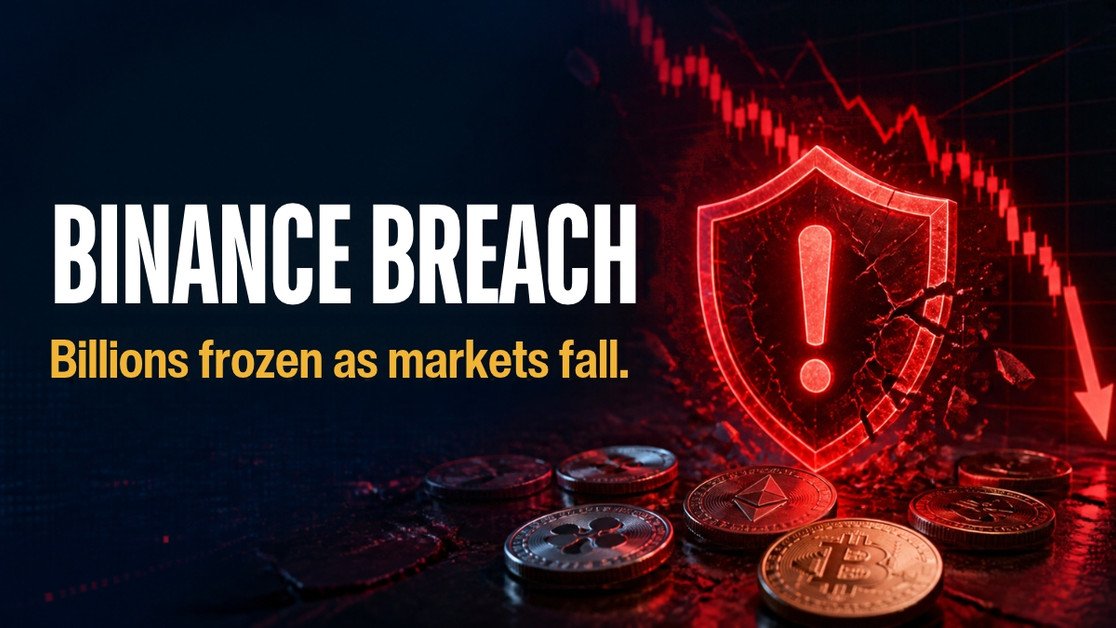
Crypto woke up on Friday 30 October to its biggest security scare in years. Binance, the world’s largest cryptocurrency exchange, reported a suspected major breach in its hot wallets — and within hours, Bitcoin had fallen to a six-week low, Ethereum to a two-month low, and roughly $3 billion in digital assets had been frozen as the industry scrambled to stop the money moving. The exact scale is still moving, so here is what is reported so far, what is still unconfirmed, and what it means for an ordinary holder.
What happened
According to Reuters’ 30 October round-up of analyst reaction, Binance said a security breach had resulted in an estimated $6.3 billion impact, which analysts said could amount to the biggest crypto heist ever. A statement quoted in that piece said that as of 8:30 p.m. Eastern Time on 29 October, at least $5.912 billion had been confirmed stolen, with funds moving across multiple blockchains including Bitcoin, Ethereum, Tron, Ripple and several Layer 2 networks.
KuCoin’s daily report gives a slightly different on-chain picture: abnormal transfers across more than 60 assets, with outflows estimated at $5.3 billion to $5.6 billion. Gross outflows, confirmed theft, frozen funds and net loss are different things, and all are still being counted. The cause has not been confirmed.
One theory is circulating. Mark Karpeles, the former head of Mt. Gox, suggested the attacker somehow obtained a valid delegation for two Binance addresses, known as Binance 14 and Binance 16, pointing to a compromised private key. That is a lead, not a confirmed cause. KuCoin separately flags the risk of secondary attacks from unrevoked EIP-7702 delegations, a newer Ethereum authorisation mechanism.
The freeze race
The most encouraging part so far is how fast the rest of the industry moved. Binance said it had worked with partners to freeze about $3 billion of the affected assets. KuCoin reports a somewhat lower frozen figure of roughly $2.39 billion to $2.54 billion, blocked with help from Tether, Circle and Ripple. The figures differ because they were captured at different moments — but the direction is the same: a large share of the stolen funds was stopped before it could be cashed out.
That freeze is possible because crypto cuts both ways. Stablecoins such as USDT and USDC can be frozen by their issuers at specific addresses. Bitcoin works differently: as ViaBTC chief analyst Jeff Ko notes, Bitcoin addresses cannot be frozen, but every coin is traceable on-chain, and Bitcoin has no mixing tool as deep or liquid as Tornado Cash — so much of the stolen BTC may stay effectively locked for years. Ethereum, Ko warns, can be laundered far more easily through Tornado Cash, which could mean ongoing selling pressure in ETH.
Binance co-founder Yi He has pledged that the exchange will cover hacking-related losses, and KuCoin reports that Binance urgently suspended deposits and withdrawals while it responds. Its SAFU emergency fund holds approximately 15,000 BTC, worth around $1 billion, according to KuCoin.
The market reaction
The sell-off was swift. Bitcoin fell to a six-week low of $77,646 in early Asian trading, according to BusinessToday, and was later reported by Reuters down about 3% at $76,469.82. Ethereum dropped to a two-month low of $2,238.76, later reported down more than 3% at $2,185.83. Binance’s own token, BNB, plunged more than 8% in 24 hours to $694. KuCoin’s data as of 00:00 UTC on 30 October put Bitcoin at $77,988.80 (down 4.12%) and Ethereum at $2,253.61 (down 4.49%), with the Crypto Fear & Greed Index dropping from 51 to 30 — from neutral into fear territory.
Shares in Coinbase slid 4.8% and shares in Strategy fell nearly 6% in extended US trading, Reuters reported, while Standard Chartered’s Geoffrey Kendrick cautioned the negative price action may still have some way to go.
The market was already nervous: the US Federal Reserve held rates at 3.75%–4.00% on 28 October, while September core PCE inflation came in at 3.1% year on year — data fuelling expectations of further rate hikes rather than cuts. The incident landed on top of that backdrop, which helps explain why panic spread so fast.
Why this one matters more than most hacks
Crypto has suffered large exchange thefts before. UOB Kay Hian’s Kenneth Goh points out that Mt. Gox collapsed in 2014 after losing close to $500 million in Bitcoin, and Bybit lost about $1.5 billion only last year. What stands out this time, Goh argues, is where it happened: the world’s largest exchange should have the strongest controls in the industry, and it has still been breached.
The knock-on effects go beyond the stolen money. HashKey Group’s Tim Sun warns that disruption to Binance’s deposit and withdrawal operations could affect market makers’ ability to move capital between venues, while 1Token founder Damon Xu adds that traders could face margin shortages and forced liquidations if they cannot access capital on one venue.
There is a flip side. 1Token founder Damon Xu notes that decentralised exchanges could benefit, pointing to Hyperliquid’s strong performance as some activity migrates on-chain. And Bitbank’s Yuya Hasegawa offers the calmer view: Bitcoin’s underlying fundamentals have not been directly compromised, and if Binance can show customer assets remain secure, cover losses and restore normal operations promptly, the impact could prove relatively short-lived. After the Bybit hack, Ko notes, markets took only weeks to recover.
What should an ordinary holder do?
First, do not panic-sell on headlines alone — and do not trust anyone who contacts you claiming to be Binance support during an incident like this. Phishing attacks surge exactly when users are anxious, so only use Binance’s official app, website and announcements, and never share passwords, codes or seed phrases with anyone.
Second, check the practical facts: reports say deposits and withdrawals at Binance were suspended during the response, so if you cannot move funds, that may be a temporary safety measure rather than a loss of your assets. Wait for Binance’s official updates on when normal operations resume.
Third, use the scare as a prompt for basic security: strong unique passwords, two-factor authentication, and — for crypto you plan to hold long-term — a hardware wallet where you control the keys, rather than leaving everything on any single exchange. If you use Ethereum wallets with smart-account delegations, review and revoke any delegation you do not recognise.
The Binance breach is still unfolding, and today’s numbers will be revised. The story to watch is not just how much was taken, but how much is recovered, how quickly users are made whole, and whether confidence in centralised exchanges takes a lasting hit.
This post is for information only and is not financial advice. Figures quoted are as reported on 30 October 2026 by Reuters, KuCoin and BusinessToday, and are subject to revision as Binance’s investigation continues. Cryptocurrency markets are volatile — do your own research before making investment decisions.