Washington cuts MEXC off from US banks
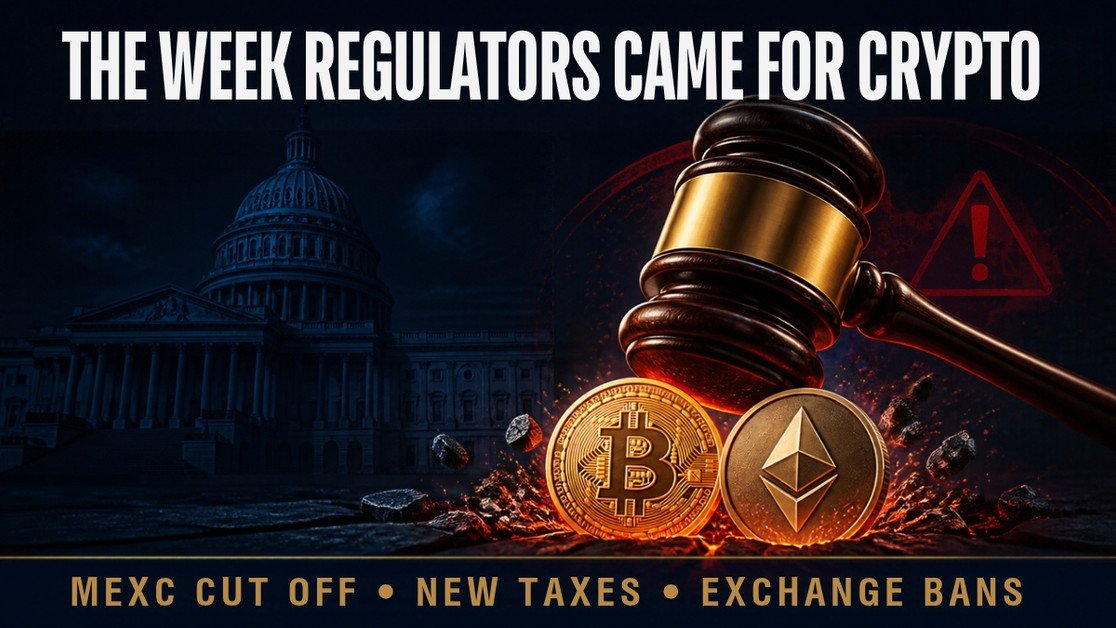
It was the week the world’s regulators stopped talking about crypto and started acting on it — all at once, on three continents. Washington moved to cut a major exchange off from the American banking system entirely. Greece passed its first crypto tax law. Thailand moved to block another big exchange. And Russia opened its doors to retail crypto trading under strict new limits. For anyone holding crypto, the message of the week was simple: where you trade, and how you report it, matters more than it did a month ago.
On Friday 6 November, the US Treasury’s Financial Crimes Enforcement Network (FinCEN) issued an order that will bar American financial institutions from processing any funds transfers involving MEXC Global, one of the world’s largest crypto exchanges. Treasury alleges the platform facilitated at least $16 billion in transactions linked to illicit activity between May 2021 and May 2026 — including sanctions evasion by Iran, North Korea and Russia, and cybercrime.
FinCEN says nearly $1.5 billion of the flows were tied to Russian sanctions evasion, including dealings with the sanctioned exchange Garantex and its successor Grinex as recently as June 2026. About $22 million was linked to Iran’s central bank and the Revolutionary Guard’s Qods Force, and roughly $1 billion moved directly between MEXC and more than 40 Iranian crypto exchangers.
The order was issued under section 9714(a) of the Combating Russian Money Laundering Act, designating MEXC a “primary money laundering concern in connection with Russian illicit finance”, and sits inside Operation Economic Outcast, the Treasury campaign launched in August to cut Iran off from global finance. It is the largest exchange ever hit under this provision.
Two qualifications matter. This is an agency finding in an administrative order, not a court judgment or a criminal indictment — and a funds-transmittal ban, not a full sanctions designation. It takes effect 30 days after publication in the Federal Register, so the clock has not started yet, and MEXC says it is operating normally and is reviewing its controls. But once the ban bites, no US bank will be able to move money to or from MEXC — including crypto transfers — effectively severing the exchange from the dollar system. As of September, MEXC was processing more than $1 billion in transactions a day and held roughly $4.5–5 billion in assets. Losing US banking access is a structural blow, not a fine to be absorbed.
The same week, the Treasury sanctioned eight Canadian money-service companies accused of exchanging Iranian rials and other currencies for digital assets, including dealings with addresses linked to Iran’s Revolutionary Guard. Enforcement is moving from individual wallets to the plumbing — the exchanges, banks and payment firms that connect crypto to the rest of the financial system.
A tax law in Greece, a ban in Thailand
Greece’s parliament approved the country’s first comprehensive crypto tax framework: a 10% tax on capital gains, with the first €500 of net annual gains exempt, and a 15% levy on income from staking, lending and DeFi, treated as interest income. The rules take effect for tax years starting 1 January 2027.
The rate sits at the low end of Europe’s patchwork — EU countries tax crypto gains at anything from 8% to 30%, with no unified system — but the direction is unmistakable: crypto is now taxed like any other asset, including when coins are spent on goods and services rather than sold for cash. One open question: the Finance Ministry says swapping one crypto for another will not trigger tax, but parliament’s own scientific service has warned the bill’s wording could cover such trades. Directives due in the coming weeks will settle it.
Thailand moved toward exclusion. Its Securities and Exchange Commission filed a criminal complaint against BG Limited, the operator of the Bitget exchange, alleging it ran an unlicensed exchange for Thai users from 2022 to 2025, and has asked the government to block the platform from 5 December.
Then came the week’s counter-current: Russia’s central bank finalised rules letting exchanges offer Bitcoin, Ether and USDT to ordinary retail investors from 17 November, capped at 300,000 rubles (about $3,700) a year per intermediary, with peer-to-peer trading to be banned from 1 July 2027. Some governments are building walls; others are building gates.
What this means for ordinary holders
Where you trade matters more than ever. The MEXC order shows enforcement now targets an exchange’s access to banking, not just its licence. An exchange that loses its dollar rails can keep trading for a while, but getting money in and out becomes steadily harder. If you use an offshore exchange, know whether it is licensed where you live — Thailand’s Bitget users are about to find out what happens when the answer is no.
The tax net is widening, and record-keeping is the defence. Greece is one more jurisdiction bringing crypto gains into the ordinary tax system, with a small exemption that will not cover most active traders. Clean records of buys, sells and swaps are now what a tax return requires.
None of this moved prices much — and that is itself the story. Bitcoin closed 7 November at about $75,746, almost flat on the day and down 2.2% on the week; Ether ended near $2,236. Total market capitalisation sat at roughly $2.52 trillion, with the Fear & Greed Index at 28 — firmly in “fear”. The market’s problem this week was not regulation but the same macro pressure as last week: US spot Bitcoin ETFs shed $1.28 billion in the week to 6 November, their largest weekly outflow since June, and Ethereum funds lost $365 million for a sixth straight week. Regulators are tightening the rules while Wall Street money is already walking out the door.
What to watch next
- The Federal Register. The MEXC ban only starts 30 days after publication — watch for the notice.
- Thailand, 5 December. The Bitget block date. If it goes ahead smoothly, expect other Asian regulators to copy the playbook.
- Greece’s implementation directives. Whether crypto-to-crypto swaps are taxable will matter to every trader in the country.
- Russia, 17 November. The first retail crypto sales under the new rules.
- Tuesday’s US inflation report. Still the number that decides whether the Fed hikes in December — and it matters more for prices than any of this week’s regulatory news.
Regulators spent the week redrawing the map of where crypto is welcome and where it is not. The direction of travel in the West is now hard to miss: the era of asking exchanges nicely to comply is giving way to cutting off the ones that do not.
This post is for information only and is not financial, tax or legal advice. Figures are as reported by the US Treasury/FinCEN, CoinDesk, Bitcoin Magazine, Reuters via FXStreet and other outlets on 5–7 November 2026; the FinCEN allegations are agency findings, not court judgments. Cryptocurrency markets are volatile — do your own research before making investment decisions.